

Ownership-first commerce infrastructure for business owners who need control when platforms fail.
SovereignStack helps business owners reduce fragile dependencies across payments, checkout, WordPress, infrastructure, and recovery — without pretending every business needs to own everything on day one.
What does “sovereign” mean here? Read the definition →

Find your single points of failure in 90 seconds.
The Risk Terminal runs an illustrative dependency scan against your store URL. Enter your domain, revenue range, and processor — it maps the failure patterns SovereignStack sees most often in single-rail commerce stacks and quantifies your exposure window.
Results are illustrative — based on common failure patterns, not a live scan of your systems. A real engagement starts with a manual review.
“Given the realities of payment dependency, platform risk, plugin fragility, and infrastructure failure, we believe business owners are better served by systems that increase control, preserve optionality, and make recovery easier.”
The failure patterns most business owners recognize
These are not hypotheticals. They are the common ways that conditional ownership reveals itself — usually at the worst possible time.
Your business may look like yours, but the infrastructure underneath it may belong to someone else.
Most business owners depend on hosting platforms, app providers, DNS providers, payment platforms, plugin vendors, SaaS dashboards, and managed systems they do not truly control. That is convenient — until something changes, fails, suspends, expires, or disappears.
If your business cannot operate without permission from systems you do not control, your ownership is conditional.
SovereignStack helps business owners understand what parts of their infrastructure are owned, rented, borrowed, or recoverable — then builds practical paths toward more control.
Map Your Infrastructure Risk →If one company controls access to your money flow, your revenue path is fragile.
Custodial processors and hosted payment accounts can be useful, but they also introduce dependency. Funds, access, account status, approval, rules, settlement, reserves, and reviews may sit outside the business owner's direct control.
When payment access depends on a single custodian or processor, the business's ability to sell can be interrupted by someone else's decision, outage, or policy change.
SovereignStack builds payment paths that preserve optionality, including BTCPay-backed Bitcoin checkout, non-custodial settlement patterns, and fallback rails where practical.
Explore Payment Optionality →Many businesses only discover how fragile their checkout is after the processor says no.
A freeze, shutdown, review, reserve, category restriction, or sudden account issue can turn a working store into a store that cannot take orders. The problem is not just payment failure. The problem is having no prepared second path.
A single payment rail is not a resilience plan.
SovereignStack designs fallback-oriented checkout systems so businesses can preserve a path forward when a primary rail fails, expires, or becomes unavailable.
Build a Fallback Checkout Path →WordPress gives business owners freedom, but unmanaged plugin stacks can become operational chaos.
A WordPress or WooCommerce site may depend on dozens of plugins, theme behavior, payment extensions, custom snippets, webhooks, cron jobs, API keys, and updates that all have to keep working together. When versioning, changelogs, compatibility, and release discipline are missing, the site becomes fragile.
A plugin stack without maintenance discipline is borrowed stability.
SovereignStack builds and maintains WordPress/WooCommerce systems with release discipline, documentation, plugin audit gates, compatibility tracking, and update awareness. Plugins are part of this, but the bigger promise is operational control.
Stabilize Your WordPress Stack →Some businesses operate where payment rules, platform policies, and legal expectations change constantly.
Category-sensitive businesses often face payment restrictions, policy changes, documentation expectations, legal uncertainty, platform review pressure, and rules that do not always move at the same speed across states, platforms, processors, and vendors.
Regulatory uncertainty becomes more dangerous when the business has no visibility, fallback path, or documentation discipline.
SovereignStack does not replace legal advice. It helps business owners build systems that are more transparent, documented, adaptable, and resilient when compliance pressure or platform review happens.
Build With More Operational Clarity →Backups are not the same thing as recovery.
A business may have backups, but no tested path to restore, redeploy, reroute traffic, verify checkout, reconnect payment paths, or bring operations back online. When something fails, they are not recovering. They are improvising.
If recovery has never been tested, it is only a theory.
SovereignStack treats recovery as part of the business stack: status visibility, backup freshness, redeployment planning, infrastructure records, and recovery tests where practical.
View Recovery Architecture →Different failures. Same root problem: lack of practical control.
Payment failures, platform restrictions, plugin chaos, infrastructure outages, and compliance pressure may look like separate problems. But they often share the same underlying weakness: the business owner does not control enough of the systems their business depends on, and they do not have a clear recovery path when those systems fail.
SovereignStack exists to help business owners:
- ▸Understand their dependencies
- ▸Control more of what matters
- ▸Preserve payment optionality
- ▸Document their systems
- ▸Build fallback paths
- ▸Recover faster when things break
- ▸Take responsibility for the stack they operate

Sovereignty is not all-or-nothing.
Start where you are. Move toward more control as your business, risk, and operational maturity grow.
- 1Use a focused toolStart with one layer that solves one pain.
- 2Add fallback pathsReduce single points of failure in checkout, payments, operations, or recovery.
- 3Take control of key railsUse merchant-controlled payment paths and self-owned systems where practical.
- 4Own the recovery planBackups, status visibility, redeployment paths, and documented recovery.
- 5Full SovereignStackA complete ownership-first commerce architecture built around control, optionality, and recovery.
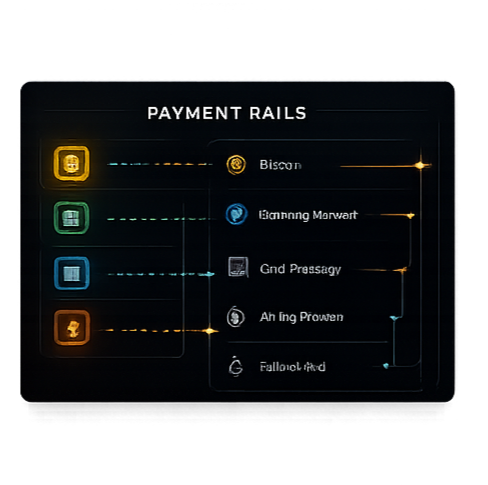
Practical layers for regaining control.
Some business owners start with a payment rail. Some need checkout fallback. Some need managed WordPress support. Some need recovery infrastructure. SovereignStack is designed as a ladder, not a cliff.
Plugins
WordPress and WooCommerce plugins built with release discipline and dependency awareness.
- → AltPay Gateway
- → Freeway Rails
- → BTCPay Checkout (Hosted WooCommerce)
Payment Rails
Non-custodial and fallback-oriented payment infrastructure for merchants.
- → SovSats
- → SovPay
- → AltPay Rails JS Modal
Checkout Resilience
Fallback checkout flows, alt-pay rails, and resilient storefront patterns.
- → Checkout Resilience
- → AltPay Rails
- → ReUp Commerce Suite
WordPress Systems
Managed WordPress builds, WooCommerce systems, and plugin maintenance services.
- → Website Builds
- → Custom Next.js Builds
- → Custom Sovereign Hosted Builds
Infrastructure & Recovery
Deployment, status monitoring, and recovery infrastructure for business operations.
- → Up247Time
- → Recovery Planning
- → Status Layer
Built to be proven, not just claimed.
Status, demos, changelogs, audit trails, and recovery records are part of the system. Not decoration.
Helsinki node status, endpoint checks, SSL, backup freshness — honestly labeled.
Interactive checkout with multi-rail payment and graceful fallback simulation.
Deployment topology, snapshot schedule, and recovery test records.
SovereignStack products maintained through internal audit and release workflows before distribution.
“Sovereignty is not the refusal to participate. It is the refusal to build your business on dependencies you do not understand and cannot recover from.”
SovereignStack is not about avoiding responsibility, ignoring rules, or pretending obligations disappear. It is about meaningful control — and the responsibility that comes with that control.
Read the full definition →Tell me what broke. I’ll show you the right path.
Dependencies fail. Know where they are. Reduce the ones that matter. Prepare for the rest.