
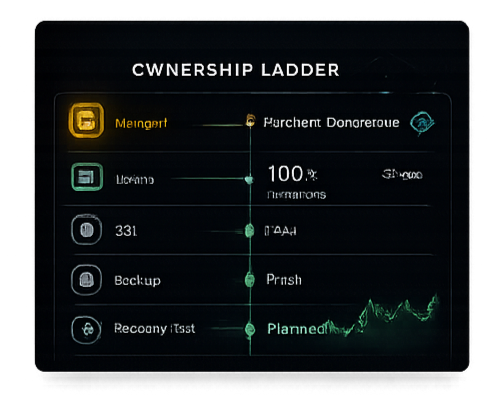
Sovereignty is not all-or-nothing.
Start where you are. Move toward more control as your business, risk, and operational maturity grow. The Ownership Ladder is not a target — it is a map.
Use a focused tool
Start with one layer that solves one pain.
You do not need to rebuild your entire stack to start improving your situation. A single plugin that adds a non-custodial payment rail, or a single service that puts discipline around your plugin updates, changes your risk profile without requiring a full architecture overhaul.
- →Add SovSats Checkout to your existing WooCommerce store
- →Set up BTCPay Server as a payment option alongside your current processor
- →Audit your current plugin inventory with the SovereignStack Agent
Add fallback paths
Reduce single points of failure in checkout, payments, operations, or recovery.
Once you have identified your single points of failure — one payment processor, one hosting provider, no recovery plan — you start adding backup paths. Not replacements. Backups. The goal is that when one path fails, another is ready.
- →Configure a second payment rail alongside your primary processor
- →Set up staging environment and test restores before they are needed
- →Document DNS configuration and SSL certificates so they can be recovered
Take control of key rails
Use merchant-controlled payment paths and self-owned systems where practical.
At this level you are moving from "I have a backup" to "I own a rail." Your BTCPay node settles to a wallet you control. Your hosting is on infrastructure you manage. Your plugin stack is documented and update-tested. Key dependencies are understood and chosen deliberately.
- →Deploy self-hosted BTCPay Server on merchant-controlled infrastructure
- →Move WordPress hosting to a VPS or dedicated server you administer
- →Implement staged update testing and rollback procedures
Own the recovery plan
Backups, status visibility, redeployment paths, and documented recovery.
Recovery planning is the difference between having backups and being able to recover. At this level you have: off-site snapshots, documented redeployment procedures, a tested restore path, status monitoring, and a clear checklist for bringing operations back online after any failure scenario.
- →Implement off-site snapshot storage in a separate jurisdiction
- →Document and test a full recovery procedure end-to-end
- →Set up infrastructure status monitoring with honest data labels
Full SovereignStack
A complete ownership-first commerce architecture built around control, optionality, and recovery.
The full stack: self-hosted infrastructure in a chosen jurisdiction, multi-rail checkout with non-custodial Bitcoin fallback, WordPress/WooCommerce with release discipline, documented recovery architecture with tested procedures, and a status layer that shows honest real-time and historical data.
- →Helsinki or multi-jurisdiction sovereign deployment
- →Multi-rail checkout: traditional processor + BTCPay + fallback rails
- →WooCommerce with plugin maintenance and update discipline
- →Full recovery architecture with off-site snapshots and tested procedures
The ladder is a direction, not a destination.
Not every business needs to reach Step 5. A small business with a simple store and low regulatory exposure may be perfectly served by Step 2. A larger business with high transaction volume in a regulated category may need Step 4 or 5 to operate with acceptable risk.
The goal is not maximum ownership for its own sake. The goal is appropriate control given your actual risk profile, operational capacity, and business requirements.